- The Sovereign Signal
- Posts
- CDS on Private Credit, Fed Probes, and a Quiet Silver Squeeze: Four Signals of a System at Limits
CDS on Private Credit, Fed Probes, and a Quiet Silver Squeeze: Four Signals of a System at Limits
When a $348 trillion debt tower, a weakening dollar, and a drained silver vault all show up at the same time, you’re not looking at noise—you’re watching the endgame mechanics of a system quietly running out of exits.

Luke Lovett
April 11, 2026

M2 just hit a record 22.67 trillion dollars in February 2026—up about 1.1 trillion in a year, and nearly 7 trillion above where it sat before the 2020 stimulus wave.
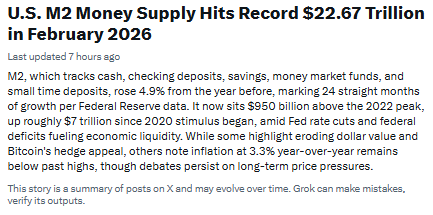
That is the tell most people miss: in a fractional‑reserve system, this kind of steady, compounding expansion of bank deposits and credit guarantees a long‑run erosion of purchasing power, regardless of whether the Fed is hiking, cutting, or pretending to be “restrictive.”
This is the story of a world so saturated with IOUs that it cannot survive honest interest rates, a credit machine pushed into the shadows because daylight would be too revealing, a monetary metal whose physical reality is starting to tear through its paper costume, a reserve currency being gently marched down the devaluation path, and underneath it all a banking system that must keep expanding credit and deposits, mechanically pushing M2 higher year after year.
Put that together, and we’re not talking about “maybe there’ll be some inflation.”
We’re describing a regime where inflation—whether it shows up in CPI, in asset prices, or in the slow theft of cash balances—is baked into the architecture.
Start with the inescapable math.
Global debt has swollen to roughly 348 trillion dollars, about 308% of world GDP.
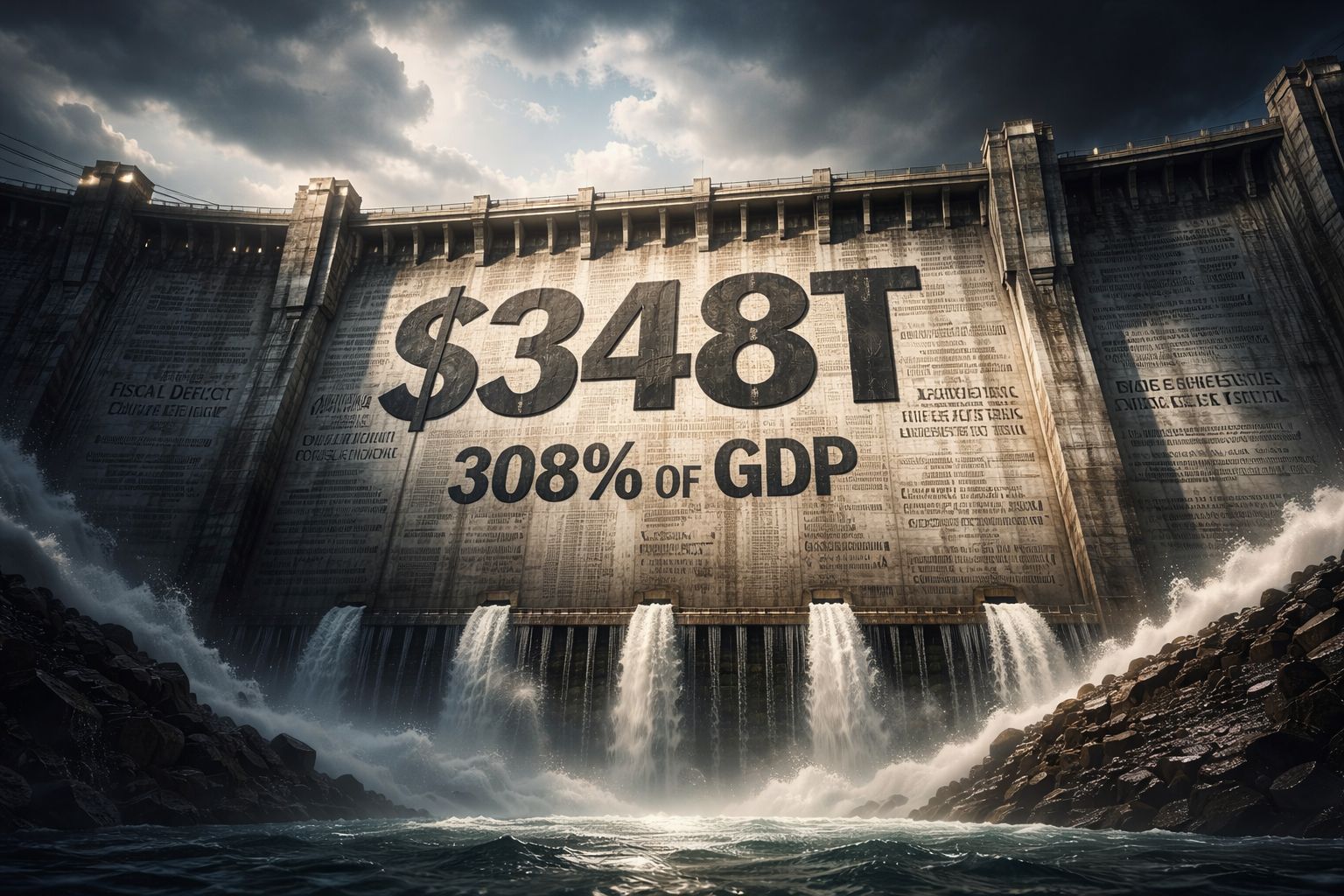
That isn’t a business‑cycle overshoot; it’s a multi‑decade political decision.
Governments are now the marginal borrowers, running chronic deficits and layering on trillions of new obligations every year.
In that world, “normal” interest rates are incompatible with solvency.
So central banks do the only thing they can do: they pin real rates below growth and inflation, suppress term premiums, and lean on the curve until it stops looking like a market and starts looking like a utility.
At the same time, the banking system keeps doing what a fractional‑reserve system is designed to do: create money whenever it creates credit.
Every new loan appears as a fresh deposit somewhere else, swelling M2.
That’s why, even after a brief post‑pandemic contraction, U.S. M2 has roared back to new highs, rising roughly 4.8–4.9% year‑on‑year into 2026 while CPI officially runs around 2.4%.
In the short run, that gap can hide in financial markets, housing, or corporate valuations.
Over time, it can’t hide at all.
If the stock of dollars is compounding faster than the stock of real goods and services, those dollars must buy less.
Rate hikes can slow the pace temporarily by curbing new lending, but as long as the system rests on fractional reserves and policy remains biased toward growth and bailouts, the long‑term direction is one way.
Once you see that, everything else clicks into place.
Pin real rates and you do not remove risk; you shove it into darker corners.
With sovereign curves financial‑engineered into submission, yield‑starved capital goes hunting.
It finds “private credit”: non‑bank lenders writing high‑yield loans to mid‑sized firms using money from pensions, insurers, and ordinary savers.
On paper, this “diversifies” the system.
In reality, it concentrates fragility where transparency is thinnest.
That’s why the Fed is now combing through banks’ links to the 1.8–3 trillion dollar private‑credit complex: supervisors have realized that this so‑called shadow system is not in the shadows at all, but wired straight into bank balance sheets via credit lines, warehouse facilities, and derivatives.
Wall Street’s answer is classic late‑cycle. Instead of shrinking the risk, it launches a new CDS index—FINDX—that lets anyone cheaply short or hedge a whole ecosystem of private‑credit managers, regional banks, and specialty lenders in a single click
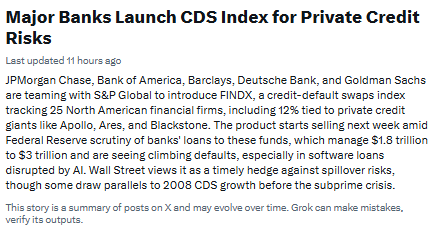
One arm of the system is asking, “How exposed are we?”
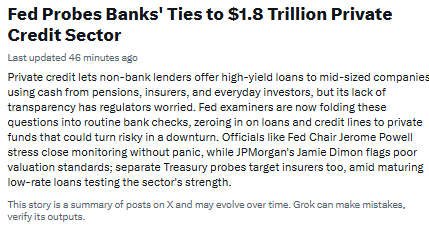
while the other arm is asking, “How can we lever and trade this?”
That’s what a hyper‑interconnected machine does when it starts to doubt its own wiring: it tries to securitize and hedge the doubt.
Now bring silver into that world.
This is not a quaint commodity side‑plot; it’s the pressure valve where the monetary, credit, and inflation stories intersect.
On the real side, the Silver Institute and other sources estimate at least five to six consecutive years of structural deficits, with cumulative shortfalls roughly equal to a full year of global mine output, driven by relentless industrial demand from solar, EVs, electronics, and AI‑era infrastructure.
Mine supply barely grows because most silver is produced as a by‑product and new primary mines take a decade or more to bring online.
The physical market is being squeezed, slowly but mercilessly.
On the paper side, the largest U.S. banks carry precious‑metals derivatives books measured in the hundreds of billions, with total metal‑linked notional across banks pushing into the trillion‑dollar zone, embedded in the same counterparty matrix that underpins rates, FX, and CDS.

Access the Signal Behind the Distortion
Debt-fueled distortions are warping stocks, credit, and global liquidity. We track the structural signals building beneath the surface — gold, silver, and the asymmetric setups mainstream coverage overlooks.
Already a paying subscriber? Sign In.
Reply