- The Sovereign Signal
- Posts
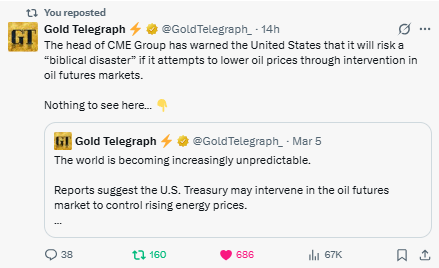
- CME Group Warns US of a "BIBLICAL DISASTER" If It Intervenes In Oil Futures Markets To Lower Oil Prices, Chain Reaction In Private Credit Stress Continues, Yen Approaching Critical Levels for Global Markets as US Taps Into ~41% of Oil Reserves
CME Group Warns US of a "BIBLICAL DISASTER" If It Intervenes In Oil Futures Markets To Lower Oil Prices, Chain Reaction In Private Credit Stress Continues, Yen Approaching Critical Levels for Global Markets as US Taps Into ~41% of Oil Reserves
Tell me there may be widespread and aggressive manipulation in commodity markets without telling me there may be widespread and aggressive manipulation in commodity markets.

Luke Lovett
March 13, 2026
If a senior CME figure is publicly warning against government pressure on oil futures, that tells you at minimum that:
1. The idea is credible enough to address publicly.
Not necessarily happening everywhere, but not fringe fantasy either.
2. Strategic commodity prices are politically sensitive.
Oil, gold, silver, rates, food — these are not just “markets.”
They are inputs into inflation, public mood, and financial stability.
3. There is real concern that futures markets could be used as policy transmission channels.
That is the important part.
Not proof that they already are being aggressively controlled across the board — but proof that the possibility is close enough to reality that it must be discussed.
It does not prove broad manipulation, but it strongly suggests that intervention in strategically important commodity futures markets is viewed as plausible, relevant, and potentially systemically dangerous.
And silver is especially vulnerable to this suspicion because the structure is already weird:
huge paper volume
relatively tiny physical float
visible inventory drains
China paying physical premiums
supply that cannot ramp quickly
So the market is already primed for distrust.
That means the real implication is less:
“we now know manipulation is everywhere”
and more:
“the credibility of futures-market price discovery in strategic commodities is now openly in question.”
In a system drowning in leverage, governments are incentivized to suppress symptoms:
oil too high → political problem
gold too high → confidence problem
silver too high → inflation / scarcity signal problem
yields too high → debt-service problem
If policymakers are even thinking about leaning on oil futures because energy prices are politically intolerable, that tells you something huge:
price discovery in strategic markets has become systemically sensitive.
Why?
Because oil is not just a commodity. It feeds:
inflation
growth
margins
yields
political stability
So if oil spikes, the whole debt-heavy machine gets stressed.
And if private credit is already wobbling underneath the surface, policymakers become even more desperate to keep key prices “orderly.”
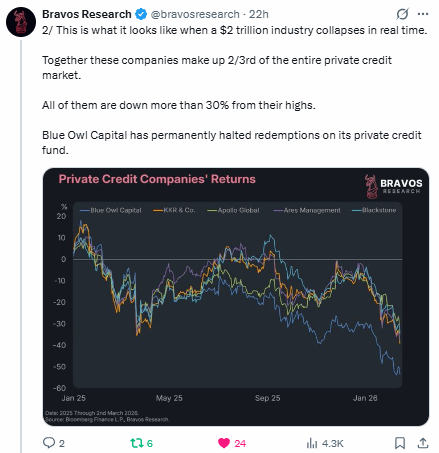
Private credit stress says:
“Liquidity is not as abundant as the marks implied.”
In the greatest debt and leverage super-cycle in history, the system survives by maintaining confidence in three things:
asset values
liquidity
collateral quality
Private credit stress undermines confidence in asset values.
Private credit stress is the market learning that not everything marked is truly liquid.
Oil-futures intervention chatter is the market learning that not every quoted price is fully trustworthy.
Silver strength amid all that is the market starting to ask:
If paper claims are fragile and strategic prices are politically sensitive, what real assets are still under-owned?
When USD/JPY pushes toward 160, it isn’t just a currency story.
It’s a global liquidity story. And right now the system is already fragile.
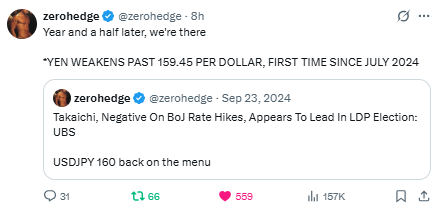
…one of the most powerful forces in global finance: the yen carry trade.
Here’s the simple version.
Investors borrow cheap yen.
They convert it into dollars.
They buy higher-yielding assets around the world.
Treasuries.
Private credit.
Equities.
Emerging markets.
Commodities.
…when USD/JPY approaches 160, three risks suddenly grow.

Access the Signal Behind the Distortion
Debt-fueled distortions are warping stocks, credit, and global liquidity. We track the structural signals building beneath the surface — gold, silver, and the asymmetric setups mainstream coverage overlooks.
Already a paying subscriber? Sign In.
Reply