- The Sovereign Signal
- Posts
- DARPA Enters Silver, Shanghai Premium Still ~13%, COMEX Shorts Keep Covering: What The Silver Market May Be Signaling Before The Crowd Sees It
DARPA Enters Silver, Shanghai Premium Still ~13%, COMEX Shorts Keep Covering: What The Silver Market May Be Signaling Before The Crowd Sees It
America is starting to realize silver matters more than it looked. Either the current price-discovery mechanism is too disconnected from real strategic supply conditions or foreign actors have enough influence over price formation that the U.S. now sees it as a defense problem, not just a trading problem.

Luke Lovett
March 27, 2026

America Is Starting To Realize Silver Matters More Than It Looked
The hard fact is simple:
DARPA’s OPEN program is real.

And its stated purpose is to improve transparency and forecasting for critical-material pricing, supply, demand, and capacity.
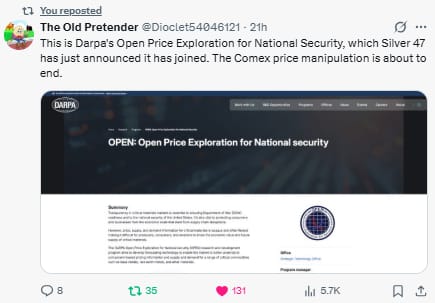
Because DARPA does not get pulled into a market unless Washington believes the issue has crossed a line — from ordinary market noise into strategic vulnerability.
That is the tell.
This is not proof, in a courtroom sense, that the silver market has been massively manipulated.
But it is strong evidence that the United States national-security apparatus believes critical-minerals pricing may be:
too opaque,
too distortable,
too detached from real strategic supply,
or too vulnerable to leave entirely to old market plumbing.
And if DARPA is involved, the cleanest read is that Washington is implicitly saying one of two things — maybe both:
Either:
the current price-discovery mechanism is too disconnected from real strategic supply conditions,
or:
2. foreign actors have enough influence over price formation that the U.S. now sees it as a defense problem, not just a trading problem.
That is a major shift.
Because the question is no longer just:
“What is the market price of silver?”
The question is becoming:
“Can the United States afford to let the price of a strategically important material be discovered in a way that is opaque, distortable, or vulnerable to foreign influence?”
That is a very different question.
And that is why this matters so much.
China Is The Test Case
If OPEN is partly about filtering out “foreign distortions,” then silver immediately raises the hardest question:
what if the foreign signal is not distortion at all?
China is the world’s largest real industrial silver consumer.

And the Shanghai silver premium has been persistent through most of the recent bull run, not just in one brief spike.
That is a huge tell.
Because persistent premium usually means something deeper than speculation.
It can mean China has been repeatedly paying up for real silver because physical demand is strong and local availability is tight.
So the real issue becomes:
is Washington trying to discover a truer silver price — or build a benchmark that prevents Chinese physical tightness from becoming the dominant global pricing signal?
That is the real question.
The State May Be Starting To Care About Silver Right As The Paper Ceiling Gets Thinner
If DARPA’s involvement suggests America is beginning to understand that silver matters more than people thought, this positioning data suggests the market may be starting to understand the same thing from another angle.
The surface read is bullish:
shorts have been covering hard,
the short side is no longer carrying the same weight,
longs have not fully abandoned the trade,
and if new buying returns, there may be less overhead paper pressure than before.
But the more important question is not whether the chart looks bullish.
It is:
Why are shorts covering now?

Because in a debt-and-leverage super-cycle, short covering in a market like silver is not just a technical event.
It can mean one of the old pressure mechanisms is becoming less comfortable.
It can mean:
the easy suppression trade is getting riskier,
physical tightness is making paper positioning more dangerous,
strategic significance is rising,
or the broader macro regime is changing in a way that makes being structurally short silver less safe.
That matters.
Because if the short base is shrinking meaningfully, then one of the main tools that helped keep silver’s price behavior “orderly” may be weakening.
And if that is happening at the same time the U.S. national-security state is beginning to circle the market, that combination is not normal.
It means two things may be happening at once:
first, the state is quietly signaling silver matters more than people think.
then, the market is showing one of the old paper pressure mechanisms may be easing.
That is how regime shifts begin.
Not all at once.
Quietly at first.
Then suddenly.
Read Between The Lines
If the short side is pulling back, it may mean the people who usually lean on this market are becoming less comfortable with the asymmetry.
And that makes sense.
Because silver is getting harder to treat as a pure paper game.
In the biggest debt-and-leverage super-cycle in history, the whole system depends on claims being larger than base reality:
more credit than real savings,
more derivatives than real collateral,
more ETF, futures, and forward exposure than immediately deliverable metal.
Silver may be one of the purest expressions of that structure.
So if the physical side is tightening while the short side steps back, what the market may be telling you is not merely:
“bullish positioning.”
It may be telling you something much more important:
the paper market is becoming less confident that it can keep ignoring the physical base.
That is the key.
The Yen Carry Trade Is The Mirror Image Of Silver
This is where the synthesis gets stronger.

If Japan is even discussing using $1.4 trillion in foreign-exchange reserves to lean on oil futures, then the message is obvious:

Access the Signal Behind the Distortion
Debt-fueled distortions are warping stocks, credit, and global liquidity. We track the structural signals building beneath the surface — gold, silver, and the asymmetric setups mainstream coverage overlooks.
Already a paying subscriber? Sign In.
Reply