- The Sovereign Signal
- Posts
- Oil Shock Feeds Treasury Panic, Silver Crashes From 69.66 To 61.24 Before Violent Re-Bid, Japan 10Y Hits 2.30%, USD/JPY Near 160, Iran Denies Trump “Talks” As Debt Super-Cycle Stress Spreads Across Markets
Oil Shock Feeds Treasury Panic, Silver Crashes From 69.66 To 61.24 Before Violent Re-Bid, Japan 10Y Hits 2.30%, USD/JPY Near 160, Iran Denies Trump “Talks” As Debt Super-Cycle Stress Spreads Across Markets

Luke Lovett
March 23, 2026
So many different takes are floating around right now because people are staring at different rooms of the same burning house.
One person sees oil.
Another sees yields.
Another sees credit.
Another sees silver getting smashed.
But these are not separate stories.
Markets are not rotating from one unrelated crisis to another.
They are reacting to a single interconnected stress event that has been decades in the making.
The greatest global debt and leverage super-cycle in modern history had already made the system acutely vulnerable to higher yields, tighter liquidity, and declining collateral stability.
The oil shock did not create that fragility.
It ignited it.

Once oil surged, inflation fear and term premium were pushed into a financial structure that could not absorb them cleanly.
That is when the real transmission began.
Oil moved higher.
Yields moved with it.
Credit stress intensified.
Liquid assets got sold for cash.
Precious metals were pulled into the same liquidity event.
Then policy panic followed.
This was not a set of unrelated reactions.
It was one stress event propagating through connected channels.
The debt-and-leverage super-cycle built the tinderbox.
The oil shock lit the match.
And everything since — the jump in yields, credit stress, liquidation, metals volatility, and sudden policy reversal — has been the fire spreading through connected rooms of the same house.
What matters here is understanding the difference between the underlying disease, the catalyst, and the transmission mechanism.
The underlying disease is decades of accumulated debt, leverage, rollover dependence, and synthetic liquidity.
The catalyst was the Iran/Hormuz oil shock.
The transmission mechanism was the bond market.
That distinction is critical.
It is not that the 10Y suddenly became some separate, bigger problem than oil.
It is that the system had already become increasingly yield-fragile because of the debt-and-leverage super-cycle, and the oil shock pushed inflation fear and term premium into a structure that could not absorb it cleanly.
The global debt and leverage super-cycle built the fragility.
The oil shock transmitted that fragility into bond yields.
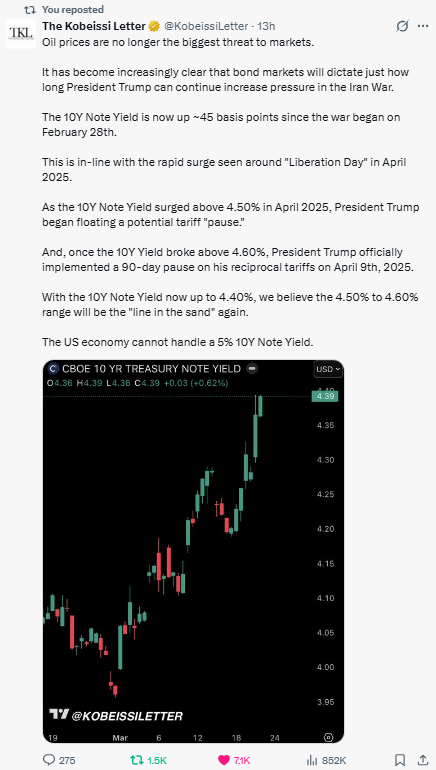
That is why the sequence matters so much.
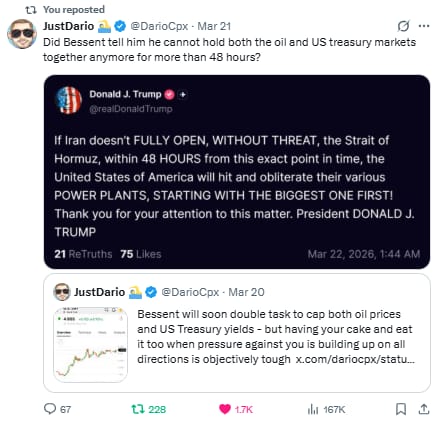
The public facts are straightforward: Trump issued the 48-hour ultimatum tied to Hormuz, Iran threatened broader retaliation if U.S. strikes hit energy infrastructure, oil surged during that escalation, and then Trump abruptly delayed the strikes for five days while claiming “productive” talks.
That does not prove motive.
But it is consistent with a White House realizing that the market and strategic fallout could be worse, broader, or less controllable than expected.
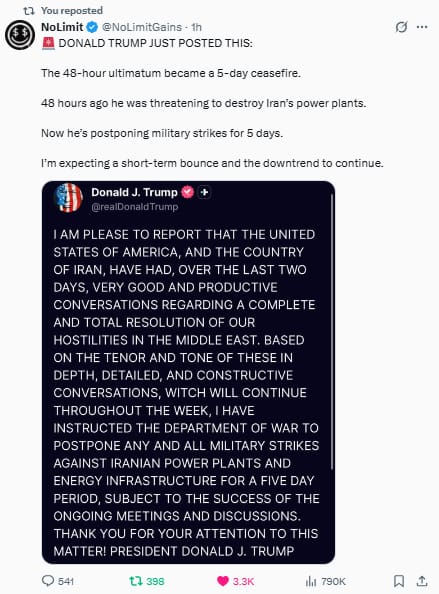
That pairing makes the reversal feel immediate and concrete.
And then came the detail that makes the entire market reaction look even more unstable:
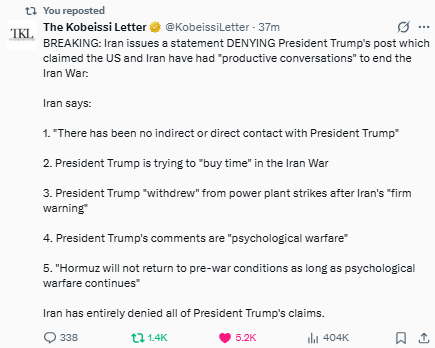
Which means the market violently repriced a de-escalation headline before that narrative was even firmly established.
That matters.
Because when a debt-saturated system is already on edge, prices stop waiting for certainty.
They lurch toward whichever headline appears to relieve pressure on yields, liquidity, and collateral.
Silver is where this became impossible to ignore.
Silver was not just weak.
The correction continued - it got absolutely pummeled overnight — from roughly 69.66 at the open to about 61.24 by 3:15 a.m.
That is not normal repricing.
That looks far more like forced liquidation.

Then, once the immediate panic/liquidation wave exhausted itself and the de-escalation headline hit, silver got violently re-bid.
That later rebound was not simply “silver liked the news.”
It was more like this:
the market puked silver in a disorderly liquidity event,
then a de-escalation headline hit,
then the same overstretched conditions that helped create the collapse helped create the snapback.
Here is the sequence:
1. violent forced liquidation
2. exhaustion / overshoot
3. headline catalyst
4. reflexive short-covering and re-bid
Silver did not get destroyed because the structural thesis broke.
It got destroyed because in a stressed, leveraged system, liquid instruments become funding tools.
When illiquid assets cannot be sold, liquid assets get sold for them.

That is one of the most important distinctions in the entire move.
That gives social-tape confirmation without relying on it as proof.
And this is where one of the more important insights comes in:
This is not the 1970s.
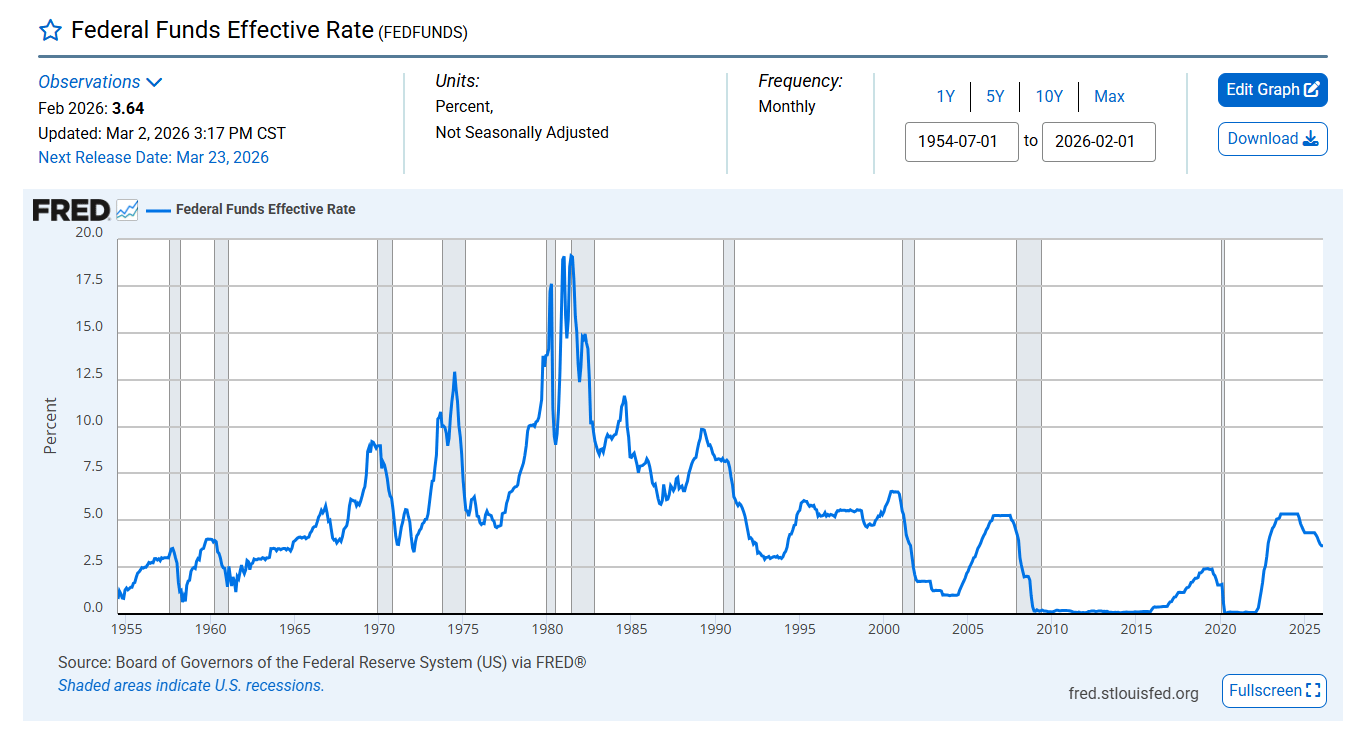
Back then, policymakers had far more room to let inflation run and then crush it with much higher rates because debt loads were vastly lower.
Today, debt levels are so extreme that sustained high rates do not just restrain inflation.
They detonate interest expense, strain fiscal credibility, tighten liquidity, and threaten the stability of the broader financial structure itself.
The system is not just vulnerable to inflation.
It is vulnerable to the cost of fighting inflation.

Access the Signal Behind the Distortion
Debt-fueled distortions are warping stocks, credit, and global liquidity. We track the structural signals building beneath the surface — gold, silver, and the asymmetric setups mainstream coverage overlooks.
Already a paying subscriber? Sign In.
Reply