- The Sovereign Signal
- Posts
- Shanghai Silver Premium at 14.5% as Large Triangle Pattern Forms In Silver, Private Credit Stress Building As Morgan Stanley and Cliffwater Cap Withdrawals from Funds, Debt & Leverage Super-Cycle Intensifies
Shanghai Silver Premium at 14.5% as Large Triangle Pattern Forms In Silver, Private Credit Stress Building As Morgan Stanley and Cliffwater Cap Withdrawals from Funds, Debt & Leverage Super-Cycle Intensifies
Being a "gold bug" or a "silver bug" is not doom and gloom, it's common sense in the greatest ever debt and leverage super-cycle.

Luke Lovett
March 12, 2026
Step back and look at these two signals together, because they’re describing the same story from two completely different angles.
When independent signals line up like this, markets tend to move hard.
First: the Shanghai silver premium.
China is the largest industrial consumer of silver on Earth.
Solar, electronics, grid infrastructure, EVs — enormous demand.

The Shanghai premium tells you one simple thing:
How badly physical buyers inside China want real metal relative to the global price.
When the premium spikes to ~14–15%, that’s not noise.
That means Chinese buyers are effectively saying:
“The global price is too low — we’ll pay more to get physical supply.”
Markets can ignore that signal for a while, but historically the Western price eventually moves toward the physical market, not the other way around.
So the premium is basically a pressure gauge on real demand.
Right now that gauge is flashing bright red.
Now look at the second signal: the price structure.
Silver broke a 46-year resistance level that capped the market around the old highs from 1980.

Breaking a resistance level that old is rare in markets. It’s like tectonic plates shifting.
But what matters even more is what happened after the breakout.
Instead of collapsing back below resistance, silver has spent weeks consolidating above it.
And not barely above.
Roughly ~60% above the old multi-decade ceiling.
That tells you something important about market psychology:
What used to be unimaginably expensive is now being treated as normal price territory.
That’s classic behavior in the early stages of a secular breakout.
Now combine the two signals.
On the technical side:
Silver is forming a large compression triangle after a massive breakout.
Inside that triangle:
• each rally gets sold earlier
• each dip gets bought sooner
So the range gets smaller and smaller.
The distance between highs and lows contracts.
That means volatility is literally shrinking.
Markets behave a lot like springs. When movement gets restricted like that, energy builds inside the structure.
Think of it like squeezing a spring tighter and tighter.
When price finally escapes the triangle, all that stored tension releases and you often get a violent expansion move.
Why it matters more in this case
In silver’s case the context makes it more powerful.
This triangle is forming:
• after breaking a 46-year resistance level
• while Shanghai premiums are elevated
• while physical inventories are draining
• while the market has a structural deficit
So technically the chart is compressing…
but fundamentally the pressure underneath the market is increasing.
That combination is why traders get excited about these setups.
Compression + strong fundamentals often precedes the moments where a market suddenly stops drifting and starts accelerating.
Silver has done this many times historically.
Long quiet coil → sudden explosive leg higher.
This is what the largest debt and leverage super-cycle in recorded history looks like when it starts grinding against physical reality.
Here’s the connection:
Debt relative to GDP is already historically extreme.
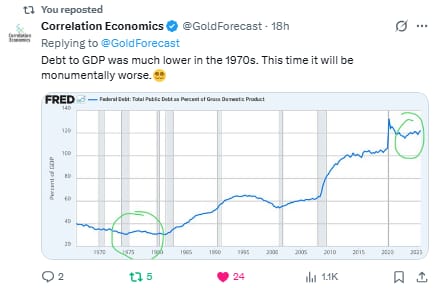
That chart is the foundation.
The system has piled up so much debt that it now depends on permanently easy money, perpetually rising asset values, and constant refinancing.
In the 1970s, debt was much lower.
Today the whole machine is vastly more fragile because the debt stack is vastly larger.
Private credit is where the rot shows up first when liquidity tightens.
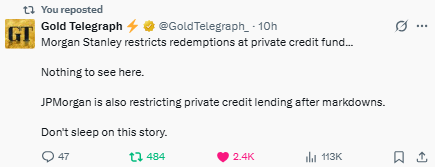
Why are Morgan Stanley, Cliffwater, and JPM restricting redemptions / pulling back lending?
Because private credit is built on the promise of yield sitting on top of illiquid assets.
That works beautifully when money is flowing in. It gets nasty when investors want cash out.
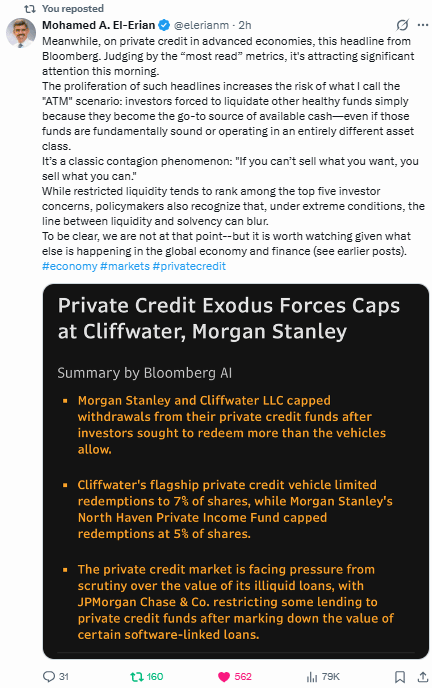
That’s the key point El-Erian is making with the ATM analogy:
When people can’t sell the thing they want to sell, they sell the thing they can sell.
That is how localized stress becomes system-wide liquidation.
Private credit freezes →
investors need cash →
they sell public equities, bonds, gold miners, whatever is liquid →
correlations go to 1 →
healthy assets get hit to fund broken ones.
That’s classic late-cycle contagion.
This is what happens when leverage outruns liquidity.
For years, the game has been simple:
borrow cheap →
buy assets →
mark them up →
use those marks as proof of stability →
borrow more.
That’s the super-cycle.
But leverage always contains a hidden assumption: that liquidity will be there when needed.
When redemption gates appear and lenders pull back, the mask slips.
The market starts discovering the difference between:
priced assets
and
liquid assets.
Those are not the same thing.
A private credit fund can say an asset is worth X on paper.
Cute. But if investors want out and there’s no real bid, the paper valuation starts smelling like cologne on a corpse.
The debt super-cycle guarantees more intervention.
This is why the debt/GDP chart matters so much.
With debt this high, policymakers cannot tolerate a true cleansing cycle for very long.
Why?
Because the higher the debt load, the less the system can withstand:
high rates
wide credit spreads
falling collateral values
forced deleveraging
So when these pressure points intensify, the response is almost pre-programmed:
more liquidity, lower real rates, more backstopping, more debasement.
Every interference keeps the structure standing while making it more distorted.
That’s why this cycle will likely be worse than the 1970s.
The 1970s had inflation, oil shocks, and monetary disorder.
But this time we have all of that layered on top of:
far more debt
far more financialization
far more leverage
far more dependence on asset prices
far more illusion disguised as liquidity
So yes — same movie genre, much bigger budget, much more combustible set design.
This all points toward the same endgame: repricing of collateral and a flight into real things.
Private credit gating is not the disease.
It’s a symptom.
Debt/GDP exploding is not the whole disease.
It’s the accumulated fuel.
The disease is a civilization-scale dependency on leverage, rollovers, and synthetic liquidity.
And once that machine starts seizing up, every headline that looked “isolated” suddenly rhymes with every other one.
This is the debt super-cycle meeting its own limits.
This is not doom and gloom.
We are pointing out WHERE capital will run, WHAT PRICES are most likely to run.
We are pointing towards what needs to be re-valued much higher to fundamentally fix the system.
Hard assets.
If COMEX inventories keep bleeding lower while China is tight on exchange supply and India is scrambling for more, the message is simple:
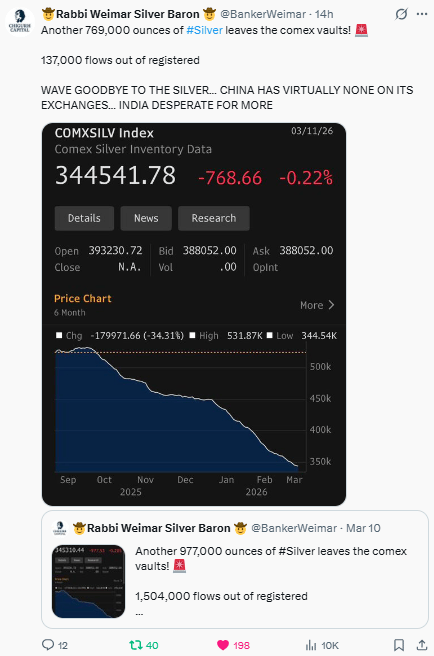
…physical metal is moving toward the strongest hands and the hungriest demand centers at the same time financial assets are revealing their liquidity illusions.
Miles Franklin provides:
Provides fully insured delivery of precious metals
Has done over 10 Billion in sales with no customer complaints
Luke Lovett
Cell: 704.497.7324
Undervalued Assets | Sovereign Signal
Email: [email protected]
Disclaimer:
This content is for educational purposes only—not financial, legal, tax, or investment advice. I’m not a licensed advisor, and nothing herein should be relied upon to make investment decisions. Markets change fast. While accuracy is the goal, no guarantees are made. Past performance ≠ future results. Some insights paraphrase third-party experts for commentary—without endorsement or affiliation. Always do your own research and consult a licensed professional before investing. I do not sell metals, process transactions, or hold funds. All orders go directly through licensed dealers.
Reply