- The Sovereign Signal
- Posts
- The Liquidity Shock Begins: S&P Depth $5.1M as $348T Debt System Faces Inevitable Yen Carry Trade Unwind🚨
The Liquidity Shock Begins: S&P Depth $5.1M as $348T Debt System Faces Inevitable Yen Carry Trade Unwind🚨
8 days ago we highlighted that a liquidity crisis may have just begun.

Luke Lovett
March 15, 2026
The point was not “a crash is here.”
The point was:
The system’s shock absorbers were thinning at the exact layers that matter most in a debt-and-leverage super-cycle:
funding
market liquidity
credit liquidity
energy buffers
Now look at this new S&P futures liquidity chart.
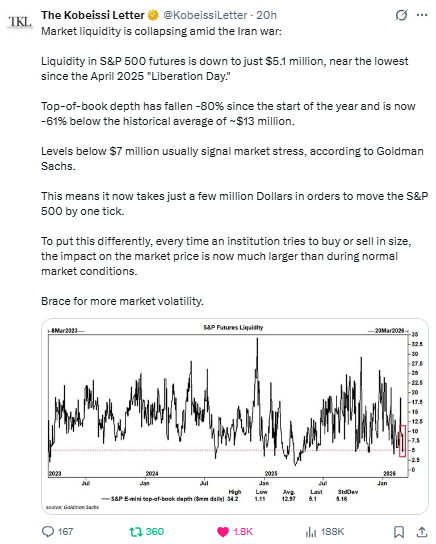
A strong system can absorb size.
A fragile system cannot.
We said the system wasn’t breaking at the top first.
It was breaking at the funding layer.
Now you’re seeing the next step:
funding stress is leaking into market-depth stress.
That is exactly how these things travel.
First, the hidden plumbing gets unstable.
Then the visible market surface starts losing shock absorption.
Then everyone acts surprised when a relatively small flow causes an outsized move.
But that’s the mechanical consequence of thin liquidity.
Why this matters so much

A debt super-cycle survives on one giant assumption:
there will always be enough liquidity to refinance, hedge, roll, and exit.
That assumption is now being challenged from multiple angles at once:
1. Energy shock risk
Oil and Middle East escalation threaten the real economy directly.


War in the Middle East doesn’t just move headlines.
It moves oil.
And when oil spikes, the entire global economy starts choking.
The Middle East is the fuel valve of the global economy.
If that valve tightens, everything gets more expensive overnight.
This isn’t just geopolitics.
It’s the world’s energy supply under threat.
When oil surges, economies feel it immediately.
War in an oil region isn’t a local problem.
It’s a global economic shock waiting to happen.
The global economy runs on oil.
When the Middle East heats up, the engine starts to stall.
You can’t fight a war in the world’s energy corridor without shaking the entire economic system.
Missiles in the Middle East often become inflation everywhere.
When oil supply is threatened, every economy on Earth pays the price.
Energy is the foundation of the real economy.
War where the oil flows means trouble for everything built on top of it.
2. Yen/carry instability
Japan’s funding role in GLOBAL MARKETS (not just Asia) cannot be understated and becomes more fragile as energy costs rise and FX pressure builds.

What happens in Japan DOES NOT STAY IN JAPAN.
1️⃣ USD/JPY is near 160
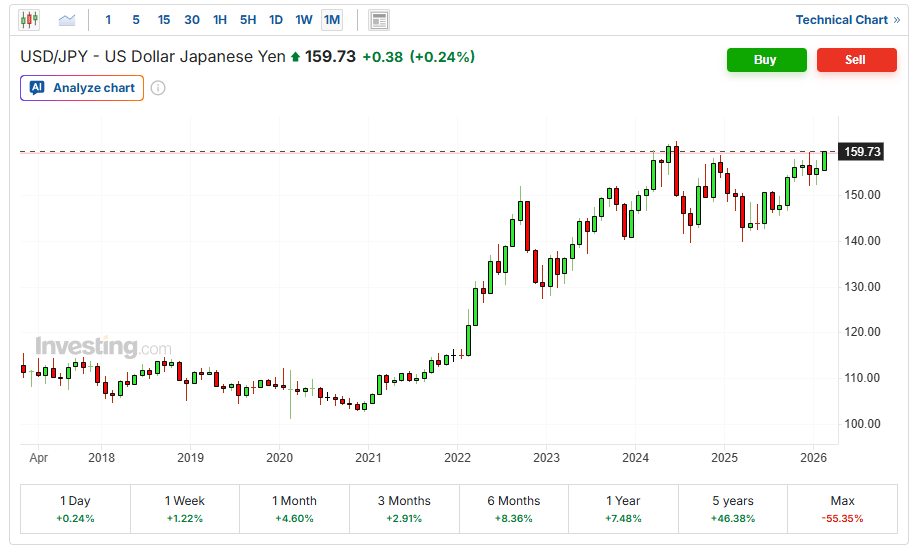
…the yen is very weak compared to the dollar.
2️⃣ Japanese 10-year bond yields are hitting 29-year highs

That means borrowing in Japan is becoming more expensive.
Those two things together create stress.
Why?
Because the carry trade only works if:
• borrowing stays cheap
• currency stays stable
Right now both assumptions are breaking.
For years the world’s hyper-leveraged markets have run on:
Borrow cheap money in Japan → invest it everywhere else.
Stocks.
Bonds.
Private credit.
Real estate.
Japan’s ultra-low rates were like cheap fuel for the global financial engine.
Now two dangerous things are happening at the same time:
The yen is collapsing toward 160
AND
Japanese interest rates are hitting 29-year highs.
That’s a DANGEROUS combination.

Access the Signal Behind the Distortion
Debt-fueled distortions are warping stocks, credit, and global liquidity. We track the structural signals building beneath the surface — gold, silver, and the asymmetric setups mainstream coverage overlooks.
Already a paying subscriber? Sign In.
Reply