- The Sovereign Signal
- Posts
- The Real Shock Is Not That Commodities Have Been Rising — It’s How Few People Understand What 76.42M Ounces of COMEX Silver, Rising JGB Yields, and Cracking Credit Actually Mean
The Real Shock Is Not That Commodities Have Been Rising — It’s How Few People Understand What 76.42M Ounces of COMEX Silver, Rising JGB Yields, and Cracking Credit Actually Mean
These are pressure points revealing the same underlying truth: the most indebted, hyper-leveraged, hyper-financialized, hyper-interconnected global economy in recorded history is increasingly colliding with physical reality.

Luke Lovett
April 04, 2026
The market keeps sorting these into neat little categories.
Commodities over here.
Gold over there.
Oil somewhere else.
Japan in another box.
Private credit in another.
War in another.
But reality is not organized that way.
These are not separate market stories competing for attention.
They are different expressions of the same structural problem.
What the crowd sees as isolated headlines are really interconnected fractures running through the same foundation.
They are pressure points revealing the same underlying truth:
the most indebted, hyper-leveraged, hyper-financialized, hyper-interconnected global economy in recorded history is increasingly colliding with physical reality.
That is the real story.
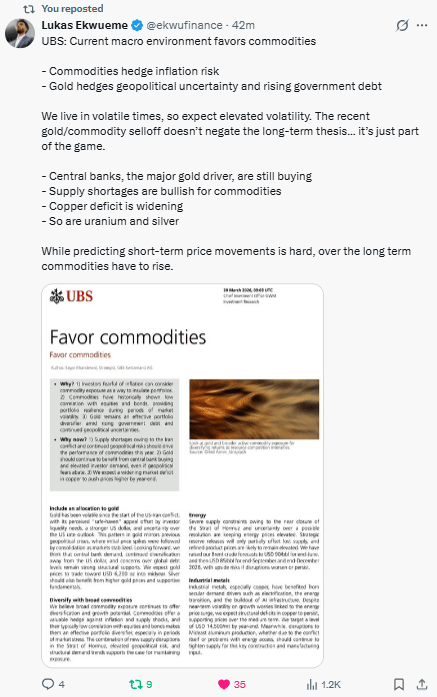
And the real shock is not going to be that commodities rise.
The real shock is going to be how few people understood that one of the most explosive real-asset re-pricings of our lifetime was unfolding while they were busy chasing noise.
Not because the evidence was hidden.
Because they were trained not to see it.
They were trained to chase symbols over substance.
Stories over structure.
Abstraction over reality.
They were trained to believe that whatever is most exciting on a screen must matter more than the raw materials that make the entire system possible.
So they chase tech.
They chase momentum.
They chase this fashionable narrative and that fashionable narrative.
Meanwhile the real world beneath them is being repriced in plain sight.
Because you can financialize reality.
You can suppress signals.
You can build leverage on top of leverage and paper claims on top of paper claims.
But in the end, the whole machine still runs on real things.
It runs on energy.
It runs on metals.
It runs on commodities.
It runs on what can actually be extracted, shipped, refined, delivered, and owned.
That is the part the market still does not seem emotionally prepared to accept.
For years, people were rewarded for believing that the abstract layer was the real layer.
That paper was wealth.
That code was wealth.
That narrative was wealth.
That multiple expansion was wealth.
Now the market is being forced to remember something ancient and inconvenient:
real assets are not the side show.
They are the foundation.
And when the most debt-saturated, leverage-soaked system in history starts colliding with physical scarcity, the repricing is not supposed to be mild.
It is supposed to be historic.
What has confused people recently is that they expected a simple script.
War begins.
Oil rises.
Gold and silver explode higher.
Equities crack.
But that is not how a fragile, leveraged system behaves in the early phase of stress.
The missing piece is that this was never just a war trade. It was a war trade plus an oil trade. A war trade plus Japan. A war trade plus funding stress. A war trade plus margin and liquidity pressure.
That is why the tape looked so strange.
Higher oil did not just mean “geopolitical risk.”
Higher oil meant more pressure on Japan.
Rising Japanese government bond yields did not just mean “local bond weakness.”
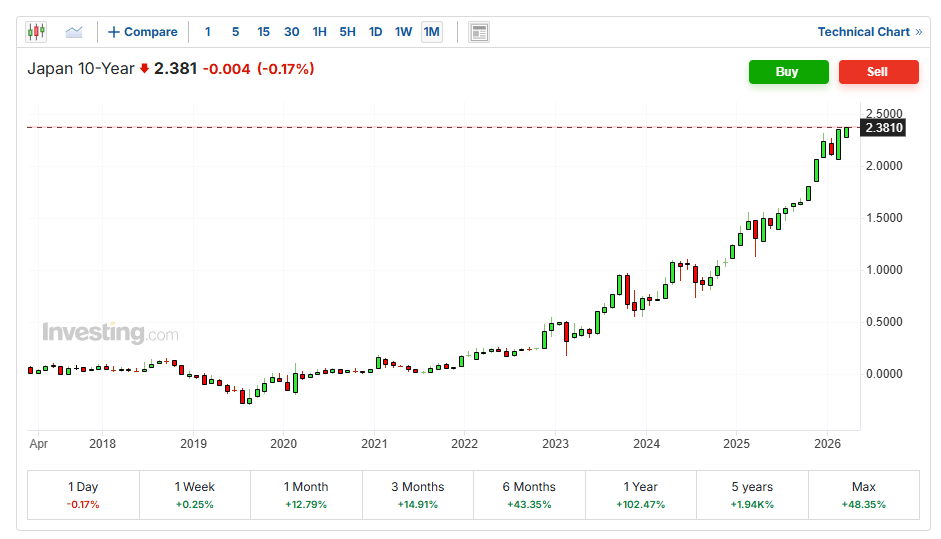
They meant tighter conditions around one of the most important funding mechanisms for leverage across global markets.
USD/JPY pressing 160 and briefly cracking that danger zone was not just an FX headline.
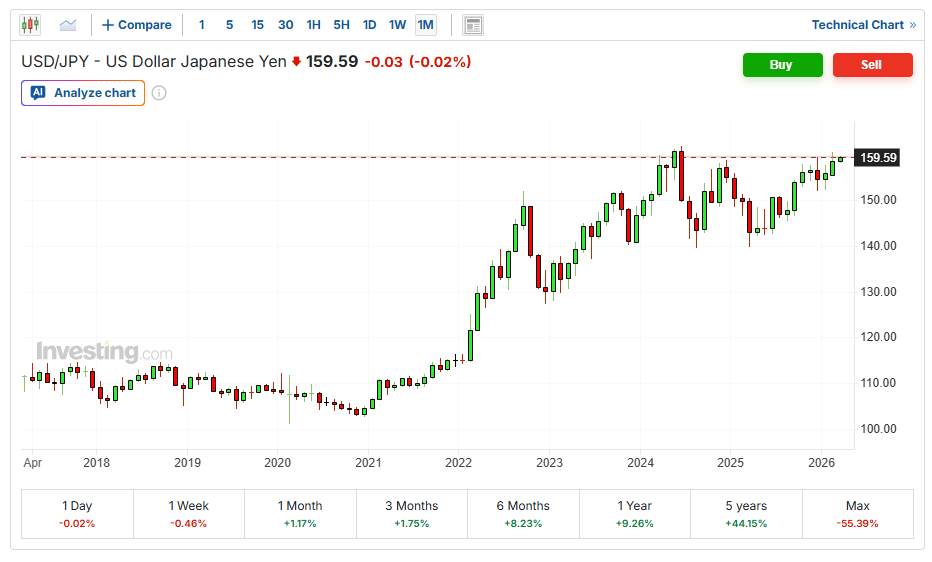
It was a warning that reverse yen carry stress was coming back into view.
And when that starts happening, the market does not move according to simplistic headline logic.
It moves according to funding logic.
Weak hands sell what they can. Levered players sell what is liquid. Nation-states raise cash where they can raise it. Profitable positions get harvested. Collateral gets mobilized.
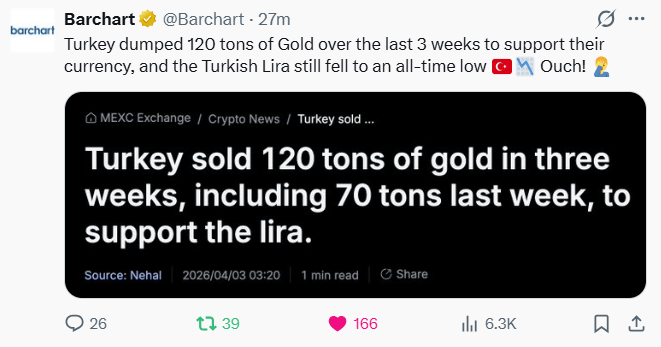
That is why gold and silver sold off more than many people expected.
Not because the thesis broke.
Because they were useful.
Gold is not just a fear trade.
Gold is reserve collateral.
Gold is liquidity.
Gold is what gets monetized when real pressure hits.
Silver, because it is smaller, more volatile, and sits on a thinner paper battlefield, gets hit even harder when gold is sold and margin stress spreads.
Equities held up better because the market still did not fully believe in a lasting, uncontrollable war escalation. It kept telling itself some version of the same comforting story:
maybe this gets contained,
maybe this cools off,
maybe policymakers manage it,
maybe the damage is temporary.
So equities were still being given the benefit of the doubt.
Gold and silver were not.
Gold and silver were being used to raise cash before the equity market fully accepted the danger.
That is the synthesis.
Equities traded disbelief.
Metals traded liquidation.
That is why the price action looked backward to people watching headlines instead of plumbing.
The same thing is happening in silver, and the signal is almost absurdly clear. Silver has been in deficit for years.
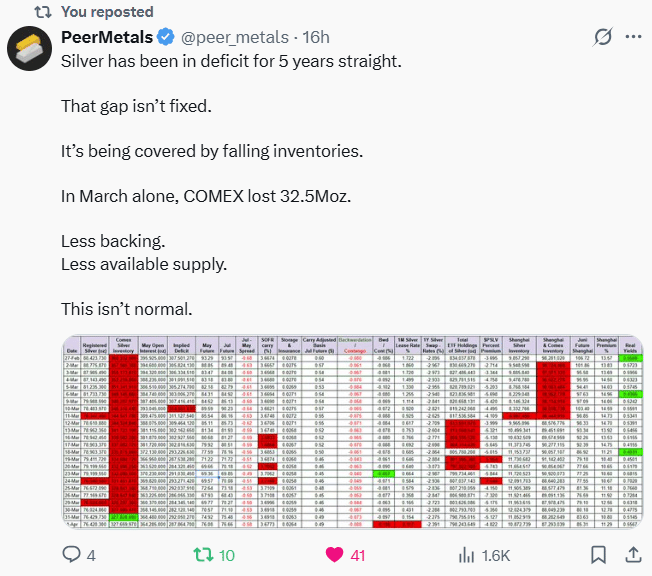
That gap has not been solved by a surge in mine supply.
It has been covered by falling inventories.
That is not a solution.
That is depletion.
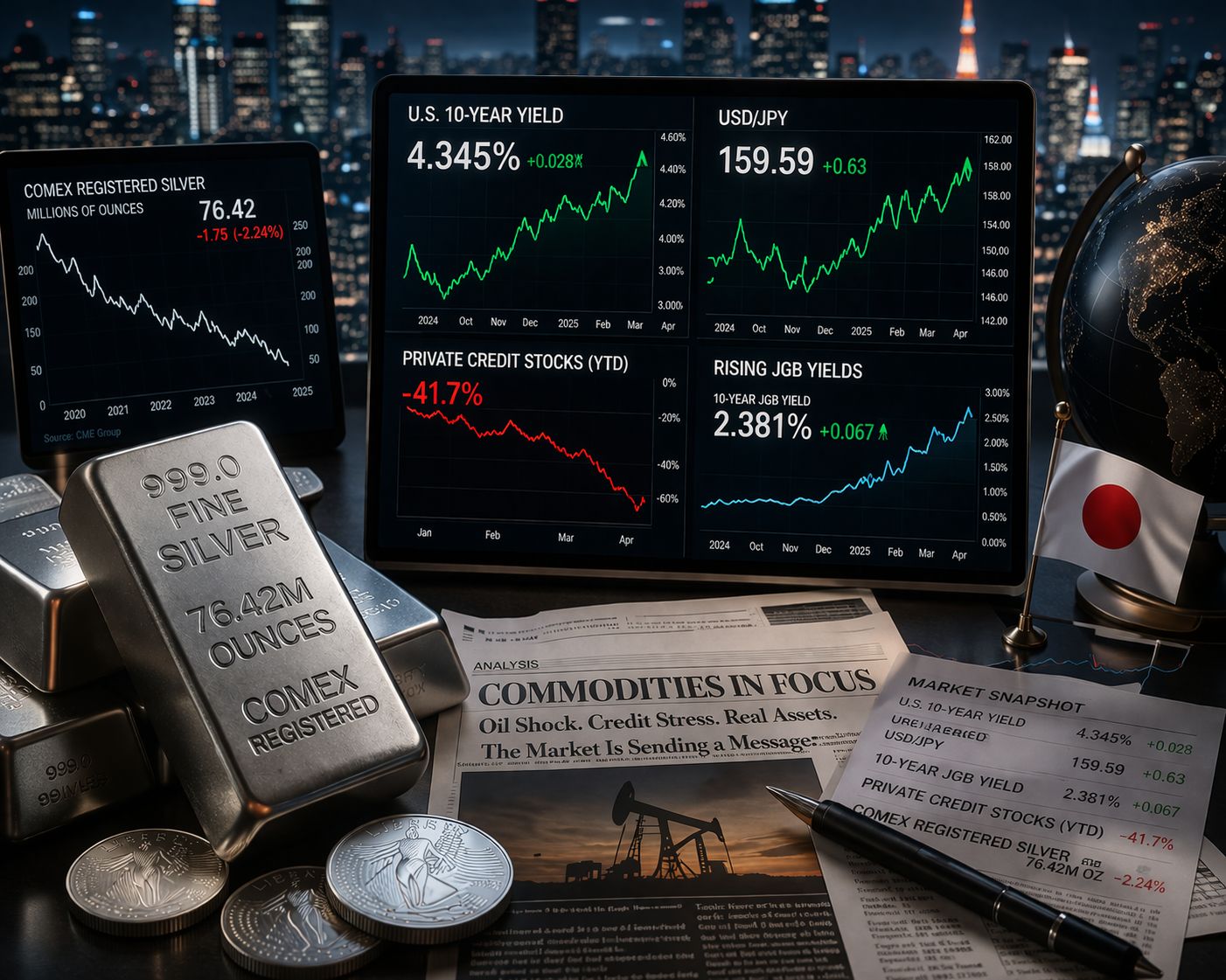
And now registered silver in the COMEX sits at just 76.42 million ounces.
That is not abundance.
That is a very thin visible cushion for a metal the modern world keeps requiring more of.
The market is still anchored to an old mental model where silver is just another volatile commodity that can drift around indefinitely on sentiment and paper positioning.
But the deeper truth is simpler.
The world runs on silver.
Industrial demand is not going away.
Supply is slow.
Supply is inelastic.
And new mine production cannot be willed into existence on command.
Even if miners focused more aggressively on silver tomorrow, the bridge from decision to new deliverable supply is measured in years, not months.
So what happens when a strategically essential metal keeps getting consumed faster than it can be replaced?
Price has to rise high enough to do the work that supply cannot do quickly enough.
Price has to ration demand.
Price has to pull future supply forward.
Price has to force recognition.
That is what higher prices are for.
And the longer the market delays that repricing, the more violent the eventual move has to be.
The same structural blindness is visible in energy and credit.

Access the Signal Behind the Distortion
Debt-fueled distortions are warping stocks, credit, and global liquidity. We track the structural signals building beneath the surface — gold, silver, and the asymmetric setups mainstream coverage overlooks.
Already a paying subscriber? Sign In.
Reply