- The Sovereign Signal
- Posts
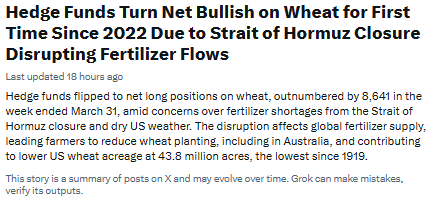
- Why Wheat Could Go Parabolic: Hormuz Threatens 20% of Global LNG, Urea Has Already Surged 46%, and Food Panic Is the Next Transmission Channel
Why Wheat Could Go Parabolic: Hormuz Threatens 20% of Global LNG, Urea Has Already Surged 46%, and Food Panic Is the Next Transmission Channel
Wheat can go parabolic when an Iran war stops being an energy story and becomes a systemic collateral, logistics, and food-security story inside the most indebted, leveraged, and hyper-interconnected global economy in history.

Luke Lovett
April 07, 2026
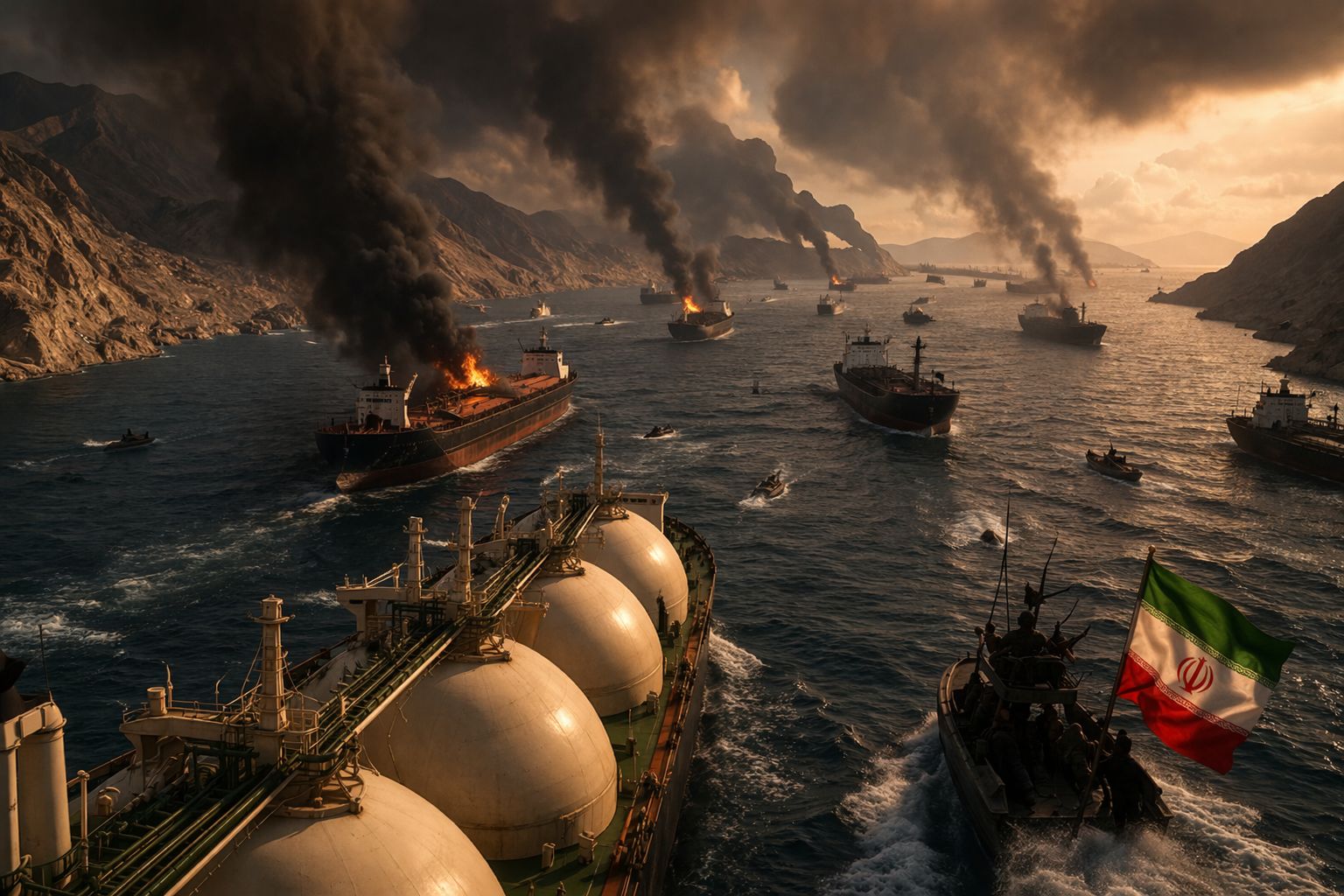
A prolonged Iran war does not make wheat go parabolic simply because oil is up.
Wheat can go parabolic when an Iran war stops being an energy story and becomes a systemic collateral, logistics, and food-security story inside the most indebted, leveraged, and hyper-interconnected global economy in history.
In a normal cycle, higher oil is just another inflation input.
In the greatest debt and leverage super-cycle ever constructed, higher oil is something else entirely:
It is pressure on the funding system.
It is pressure on the transport system.
It is pressure on industrial inputs.
It is pressure on sovereign budgets.
And eventually, it is pressure on food itself.
That is when wheat stops trading like “just another commodity” and starts trading like what it really is:
a politically explosive staple sitting downstream of energy, fertilizer, freight, sovereign stability, and social order.
That is the chain.
Hormuz energy shock
→ LNG/fertilizer shock
→ planting and yield risk
→ freight and marine insurance shock
→ importer panic buying
→ government stockpiling / export restrictions
→ futures squeeze
Not one bottleneck.
Multiple bottlenecks. Reinforcing each other.
That is how wheat stops moving higher and starts moving explosively.
1) The first punch is energy
If Hormuz remains impaired, the issue is not merely that oil is expensive.
The issue is that one of the central choke points of the modern global economy remains under stress long enough for second-order effects to become first-order reality.
Hormuz is not some peripheral shipping lane.
It is one of the pressure valves of the entire world system.
If disruption persists there, fuel costs stay elevated, shipping costs stay elevated, power costs stay elevated, and the cost of moving the physical economy rises across the board.
That matters enormously for wheat because wheat is not a weightless financial abstraction.
It has to be planted.
It has to be fertilized.
It has to be harvested.
It has to be dried.
It has to be trucked.
It has to be railed.
It has to be loaded.
It has to cross oceans.
It has to arrive where people need to eat.
So when Hormuz remains under prolonged pressure, wheat does not simply inherit “higher oil.”
It inherits a broad-based increase in the cost and fragility of the entire chain that turns energy into calories.
That is the first punch.
2) The second punch is fertilizer — and this is where the wheat thesis becomes dangerous
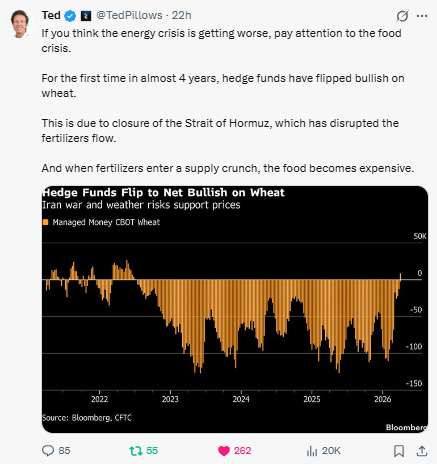
This is the part most people still do not fully grasp.
The world does not grow food on narrative. It grows food on inputs.
And one of the most important inputs is nitrogen.
Nitrogen fertilizer begins with ammonia.
Ammonia begins with energy.
So when LNG and gas markets stay tight, fertilizer does not merely get somewhat more expensive.
It gets systemically less available, more volatile, and more politically sensitive.
And that matters because wheat is one of the crops where fertilizer economics matter in a serious way.
Not cosmetically. Structurally.
If fertilizer prices stay high long enough, the consequences are not theoretical:
fewer acres get planted,
nutrient application gets reduced,
yield expectations deteriorate,
and future supply gets marked down before the market fully admits it.
This is where the Iran war stops being an “oil spike” and starts becoming a future wheat supply shock.
And in the current system, that risk is magnified by the broader backdrop:
the world is already sitting on the largest debt complex in history, the largest pile of duration risk in history, and one of the most interconnected webs of sovereign, commodity, freight, and funding exposure ever built.
That means supply-side shocks do not stay neatly contained.
They propagate.
A fertilizer shock in this kind of system is not just an agricultural issue.
It is a monetary and political issue because it attacks food at the input level.
And food is where abstract macro becomes social reality.
3) The third punch is freight and marine insurance
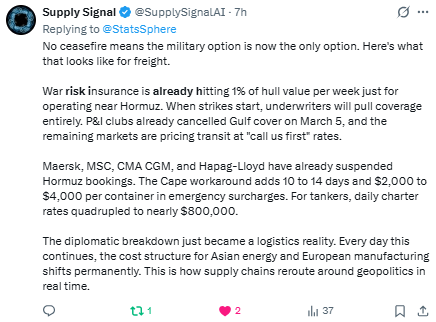
Even if there is enough wheat “on paper,” the market can still explode if confidence in moving it breaks down.
That is one of the core misunderstandings in commodity analysis:
People look at annual balance sheets as though commodities are just numbers in a spreadsheet.
They are not.
They are moving through space, time, jurisdiction, insurance markets, war-risk models, shipping lanes, and port systems.
A prolonged Iran war raises:
bunker fuel costs,
war-risk insurance,
rerouting costs,
shipping delays,
congestion,
and financing uncertainty for cargo movement.
That matters especially for wheat because wheat is not merely produced. It is traded internationally at scale as a core staple.
So the price of wheat is not only the price of growing wheat.
It is the price of reliably delivering wheat into regions that cannot afford to be short.
And once freight friction rises enough, a balance sheet that looked comfortable in calm conditions suddenly stops feeling comfortable at all.
That is when markets begin to move from arithmetic to psychology.
And once markets move from arithmetic to psychology, price can gap far beyond what “normal models” imply.
4) The fourth punch is importer panic — and this is the real accelerant
This is where higher wheat can become vertical wheat.
Because this is where the market stops asking, “What is the fair value of wheat?”
And starts asking, “Can I secure it before someone else does?”
That is a very different market.
The Middle East and North Africa are deeply dependent on imported food, especially wheat.
That means prolonged energy disruption around Iran does not just affect the cost of producing wheat.
It affects the urgency with which governments and buyers seek to secure wheat before conditions worsen further.
And once that psychology takes hold, the market changes character:
importers buy earlier than planned,
governments increase reserves,
mills over-order,
procurement accelerates,
and prompt exportable supply tightens fast.
That is when the market begins to detach from the slow-moving comfort of annualized global balance sheets.
Because it is no longer trading “global wheat supply.”
It is trading timing, access, reliability, and fear.
And fear in staple food markets is one of the most powerful forces in the world.
Why?
Because governments can tolerate a lot.
They can tolerate slower growth.
They can tolerate weaker equities.
They can tolerate wider credit spreads.
They can even tolerate currency instability for a while.
What they cannot tolerate for long is bread insecurity.
That is where the macro system becomes politically combustible.
5) Then reflexivity takes over: price itself creates more price
Once wheat starts rising for real reasons, the next stage can become reflexive.
Importers rush because price is rising.
Exporters hesitate because price is rising.
Governments begin considering restrictions because price is rising.
Traders demand more margin because price is rising.
Procurement gets pulled forward because price is rising.
At that point, the market is no longer just discounting a supply problem.
It is amplifying it.
That is how commodity markets go from “tight” to “disorderly.”
And in a hyper-leveraged global system, disorderly moves do not remain isolated.
They feed back into:
inflation expectations,
sovereign stress,
political pressure,
central bank constraints,
and broader risk pricing.
That is why this matters so much.
A prolonged Iran war is not simply a geopolitical story.
It is a test of whether the world can absorb another prolonged choke-point shock without breaking transmission across energy, inputs, shipping, and food.
And the answer, increasingly, appears to be: not cleanly.
6) What actually needs to happen for wheat to go parabolic

Access the Signal Behind the Distortion
Debt-fueled distortions are warping stocks, credit, and global liquidity. We track the structural signals building beneath the surface — gold, silver, and the asymmetric setups mainstream coverage overlooks.
Already a paying subscriber? Sign In.
Reply