- The Sovereign Signal
- Archive
- Page -475

Fed T-Bill Holdings More Than Double to $425B, Japan Confirms a Hike to 1.00%, WTI Breaks $100, and COMEX Silver Withdrawals Run 131% of Delivery Requests: The Debt Super-Cycle Is Losing Control of Its Plumbing
Rates rise in Japan and oil breaks above $100, the Fed is quietly expanding its balance sheet to keep the Treasury market functioning. At the same time, the physical layer is tightening, with silver withdrawals running 131% of delivery requests against a thin ~76–77M oz registered base, exposing how stretched the paper claims really are. When funding costs rise, energy costs rise, and physical collateral starts disappearing all at once, the system doesn’t stabilize—it loses control of the plumbing that holds it together.

Diesel +54.4%, Farm Bankruptcies +46%, China Real Estate Erasing 20 Years of Gains, and COMEX Silver Withdrawals Running 131% of Delivery Requests: Physical Reality Is Margin-Calling the Entire Leverage Super-Cycle
The system was built on the assumption that energy would stay cheap, credit would stay available, and asset prices would keep absorbing the pressure—but all three are breaking at the same time. A +54% surge in diesel is crushing the most operationally sensitive layer of the economy, a +46% spike in farm bankruptcies shows the production base is already failing, and China’s property wipeout is forcing trillions of dollars of savings to seek something real. Beneath it all, silver is being pulled from the system faster than it can be replaced, and when the physical layer tightens while leverage remains this high, the repricing doesn’t trickle—it cascades.

From LNG Deficits and Refinery Cuts to Sovereign Yield Suppression and Silver Depletion: The Market Is Repricing the True Cost of Energy, Capital, and Credibility
The energy shock is no longer theoretical—LNG has flipped from a +15Mt surplus to a –6Mt deficit, refinery runs are down 2.7mbpd, and oil hasn’t even reached the demand-destruction threshold yet. At the same time, central banks are being forced into a higher-for-longer regime in a system that cannot afford it, all while quietly preparing to cap yields and suppress the cost of debt. Beneath both layers, silver is being physically consumed—~700 tons disappearing in a month against a thin float—revealing that the real constraint is not price, but the vanishing availability of what the system actually needs.

$900M Leaving Oil ETFs While Global Inventories Drain at 7.1mbd: The Market Is Selling Paper Barrels as the Real Ones Disappear
The public is exiting exposure at the exact moment the underlying reality is tightening to its most extreme levels. A 7.1 million barrel-per-day draw is not a sentiment shift—it is a physical constraint, and when paper selling collides with real-world scarcity, price doesn’t adjust gradually, it gaps violently. This is the phase where positioning is still backward-looking, but the system itself has already moved forward—and that disconnect is where the repricing begins.

Record SOFR Spread Volume, Swap Lines Being Pre-Wired, and $25B Month-End Equity Selling: The Plumbing Is Easing While the Narrative Still Says Tight
The market is telling us policy is restrictive—but the plumbing is quietly doing the opposite. Record SOFR spread positioning, emergency dollar swap lines being lined up behind the curtain, and a mechanical $25B equity seller arriving on schedule all point to the same reality: liquidity stress is already forcing the system to adapt. By the time the narrative catches up, the repricing will already be underway.

51 of 52 Sovereigns Above 130% Debt-to-GDP Have Defaulted, the Dollar Has Slipped to ~45% of Reserves, and the Yen Keeps Falling Under Yield Caps: This Is What Monetary Regime Drift Looks Like Before It Becomes a Crisis
A private credit default wiped $5B last night. The industry asked the SEC for permission to sell the rest to retail. Spreads started widening. Breadth is the narrowest ever at ATHs. Semis printed the longest win streak in history. Corporate interest burden is the lowest in 60 years — and the gift expires. Americans feel worse than 2008. Saudi crude at record premium. Urea doubled.

Two Clocks, One Blockade
Six weeks of jet fuel. Twenty thousand flights. Twenty-eight turned-back tankers. Eleven-dollar East-West silver premium. Four hundred and forty-two house-account stops. Three hundred thousand tech jobs gone. Fifty-one million depressed Americans. One Fed chair nominee admitting the game. One Treasury warning about TSA paychecks. One $3.3 million call ticket on $15,000 gold.

IMF Says Debt to 100% of GDP by 2029, 95% of Reserve Managers Are Buying Gold, The US Carries Gold at $42.22 While It Trades Near $4,800, Airlines Cancelling Guidance on $200 Jet Fuel, and a Third of Fertilizers ‘At Risk’ - The Repricing That Will Blindside Anyone Trusting the Index
The gap between our portfolios and the physical world is now measurable in trillions—and closing fast.

36% More to Run a Car, 13% Fewer Phones: How the Real Economy Is Screaming While Markets Cheer
The screen says “everything is fine.” The real world is screaming that it isn’t. Markets spent the weekend trading the idea that the Iran war is basically over, that oil will drift neatly back into a $60–70 range for the next decade, and that gold and silver are “boring” again.

22% Call Skew, 37% Above‐Average Upside Buying, 6 Years of Silver Deficits, 5 Historic 18% Gold Washouts: Why Positioning Misprices the Super‐Cycle
Institutions just spent a week buying roughly 22% more calls than puts, with call volumes running 37% above the post‐January‐2025 average and at record levels, even as the silver market racks up its sixth straight annual deficit and gold exits its fifth 18%‐plus drawdown since 2006—a pattern that has historically seen the metal higher 12 months later every single time.

Negative Breadth at the Top, Positive Feedback at the Bottom: How Mega-Cap Mania Masks a Bond Market on Edge and a Commodities Market on the Verge of Revolt
A record‐high S&P riding on negative breadth is not a sign of strength; it’s the exhaust fumes of a market crowding into fewer and fewer mega‐caps while front‐end bond yields stay war‐elevated. Beneath that surface, physical crude is clearing at emergency premia even as futures pretend the Hormuz shock is almost over, policymakers are openly gaming out a “vicious” Treasury demand break, and stealth buybacks are already leaning against gravity. At the same time, COMEX silver inventories are scraping bottom, silver is being pulled into “critical mineral” geopolitics, and the entire complex of oil, bonds, and bullion is starting to price a reality that headline indices and prediction markets still refuse to see.
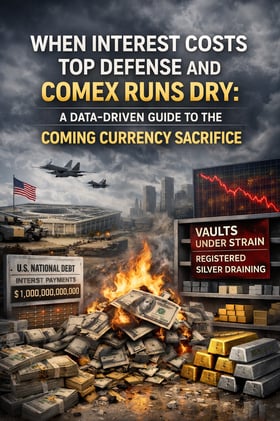
When Interest Costs Top Defense and COMEX Runs Dry: A Data‐Driven Guide to the Coming Currency Sacrifice
Interest is now the second‐largest line item in the U.S. budget, quietly overtaking defense while markets party at record valuations. At the same time, COMEX silver stocks have been bled down to historic lows as miners and industrials walk away from the paper game and lock in real metal. This is the story of what happens when the bill for decades of exponentially increasing leverage and under‐investment finally comes due—and why the only thing left to sacrifice is the currency itself.